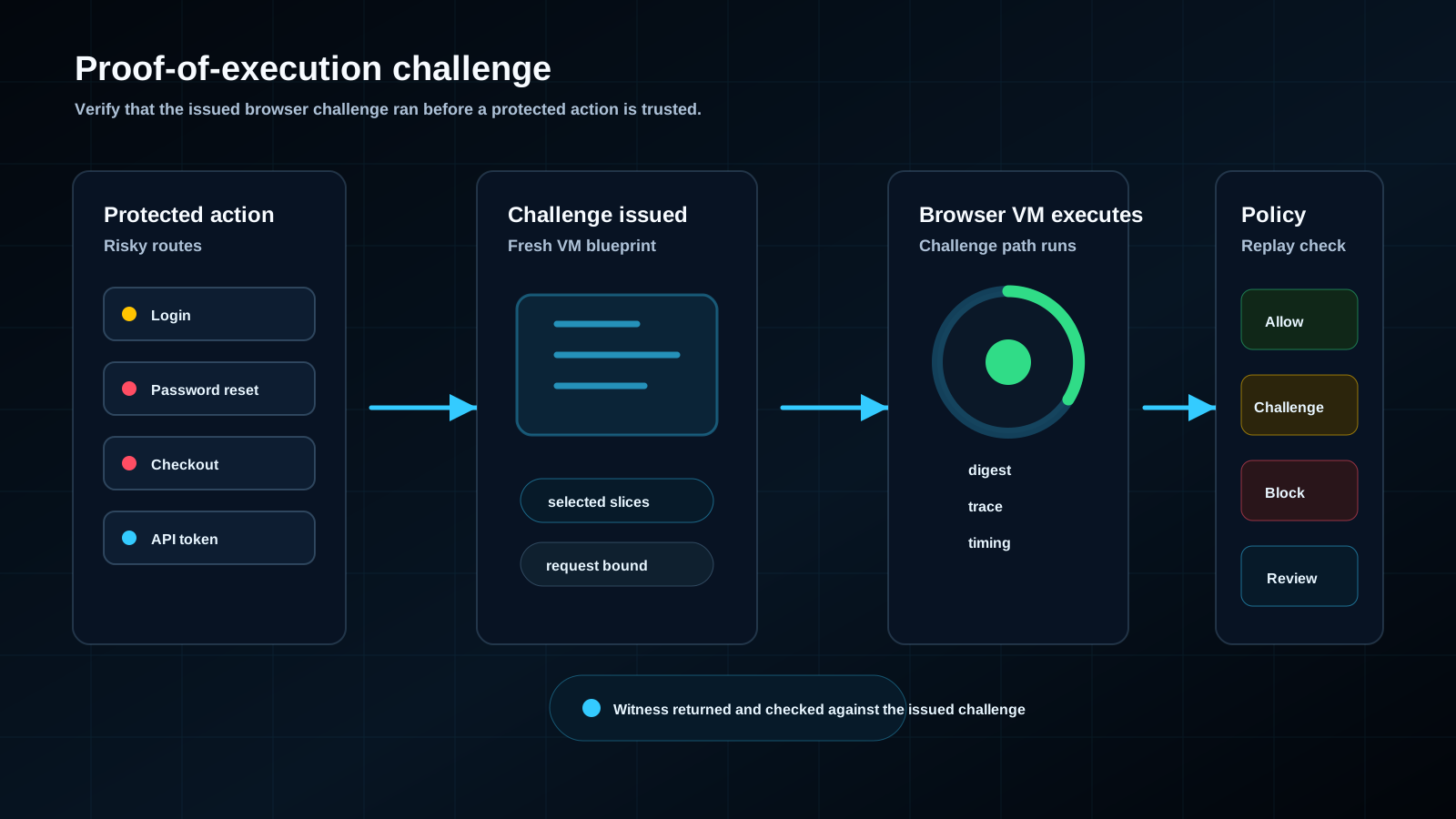

API bot abuse rarely stays politely inside one endpoint.
A campaign may start at login, move through token refresh, test account recovery, check saved addresses, probe checkout, abuse coupons, scrape product availability, and then return to account actions once a working session is found. Looking at each route alone makes the activity seem smaller than it is.
The pattern matters more than the individual request.
That is why API bot protection has to follow journeys, not just endpoints.
Login Is the First Measurement Point
Login endpoints are the obvious place to look for bot abuse. Credential stuffing, password spraying, brute force attempts, and token abuse all show up there.
But the login endpoint is only the first measurement point. Attackers are not trying to create a failed-login graph. They are trying to find usable accounts and move to the next action.
A bot campaign may keep failed attempts low per IP address. It may rotate through residential proxies. It may slow down to avoid simple thresholds. It may mimic the browser request shape closely enough to get past a basic check. It may use an API route that exists for the mobile app rather than the public login form.
So the useful question is not just "how many login attempts did we see?" It is "which client, route, network, fingerprint, account, and response pattern suggests automation?"
That is where bot management belongs in the account journey. It should not be an isolated "human or bot" label. It should become part of the request evidence used for login, recovery, checkout, and account-change decisions.
Checkout Abuse Is Often API Abuse
Checkout abuse is not always a stolen-card problem. It can be a request-path problem.
Bots can test coupon codes, reserve inventory, create carts, check delivery combinations, retry payment flows, and exploit business logic at machine speed. Some of this happens through visible browser journeys. Much of it happens through APIs used by the front end or mobile app.
The damage is not always dramatic in a single request. A few extra cart creations may look normal. A small number of coupon checks may be expected. A payment retry can be legitimate. The problem is the campaign shape across routes.
If the same automation profile moves through login, cart, promo, shipping, and payment APIs with abnormal timing or sequencing, the response should not depend on one endpoint crossing a crude global limit.
It should be route-aware.
A checkout API can tolerate different behaviour from a catalogue API. A payment route deserves different thresholds from a product search route. A coupon route may need controls around account age, session state, rate, and client evidence. A cart route may be harmless in one context and abusive in another.
Account Journeys Need Sensitive-Action Controls
Account abuse becomes most damaging when a session moves into sensitive actions.
Changing an email address, resetting a password, adding a new delivery address, viewing stored payment details, redeeming loyalty value, or placing an order are different from normal browsing. They deserve stronger context.
The request may be technically valid. The token may pass validation. The password may be correct. The API schema may be satisfied. That does not mean the action is safe.
A strong control model looks at the full path into that action. Did the session begin with credential stuffing signals? Is the client first seen? Did the network change? Is there proxy or fingerprint drift? Has the account recently failed login attempts? Is the request cadence consistent with a human journey? Is the action unusually soon after authentication?
These are not abstract "zero trust" slogans. They are practical checks on the account request path.
Rate Limits Need Better Keys
API abuse prevention often starts with rate limiting, but IP-only limits struggle with distributed automation and shared networks. The hard part is deciding what to count.
For API bot abuse, useful rate keys can include route, method, account, token, API key, response code, ASN, country, TLS or HTTP fingerprint, verified bot state, and combinations of headers. The right key depends on the journey.
A login endpoint might count failed attempts by account and fingerprint. A token endpoint might count refresh patterns by client and session. A checkout route might count attempts by account, payment state, and client fingerprint. A partner API might count by API key and route.
Advanced rate limiting is valuable because it can model the abusive actor more precisely than a single IP address. It also gives teams response options short of blanket blocking: log, challenge, throttle, or deny depending on the route and risk.
That matters because real API traffic includes customers, mobile apps, partners, service clients, good bots, bad bots, and increasingly AI-driven agents.
Agents Will Make the Journey Problem Harder
The next wave of automated API use will not all look like simple scripts. As discussed in Agentic AI vs. Your API, reasoning agents can explore, adapt, and change their behaviour based on responses.
That does not mean every AI agent is malicious. It does mean endpoint-by-endpoint rules will age quickly.
A reasoning agent can try one path, observe the result, and adjust. It can move from documentation to browser-backed APIs to mobile-shaped requests. It can test which routes are protected, which errors reveal state, and which actions trigger stronger checks.
Defence needs the same journey view. The campaign should be visible as it moves, even when the exact request pattern changes.
Keep Evidence Attached to the Campaign
API bot abuse is easier to manage when the evidence stays attached.
The useful record is not just "blocked by rule 42". It is the route, account state, token or key context, fingerprint, proxy signal, rate key, response pattern, action taken, and protected business step. That evidence lets teams tune controls without guessing and investigate incidents without reconstructing the whole path from raw logs.
For broader background, API abuse prevention covers the categories. The operational point is narrower: login, checkout, and account APIs should not be defended as separate islands.
Attackers use the journey.
The defence should too.