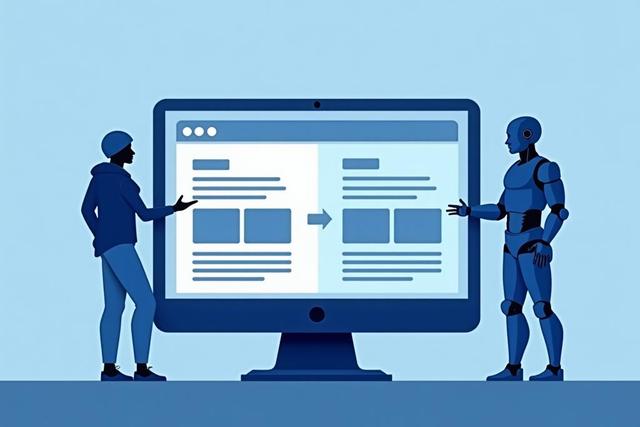

Marketing traffic is no longer just human traffic. We spent months analysing how AI agents interact with websites, and the findings put pressure on a core assumption behind digital marketing: that campaign data mostly reflects human behaviour.
Consider a simple A/B test on a landing page. The data shows a clear winner, with conversion rates 30% higher than the control. You ship the change, then the live result misses the forecast. One possible cause is that AI agents were counted in the test population.
This is not speculation. We have observed AI agents, from shopping bots to research tools, interacting with marketing campaigns in ways that weaken traditional metrics. These agents do not behave like people. They optimise for efficiency, not experience. They follow patterns, not preferences.
The consequence is straightforward. A/B test results may reflect what works best for AI agents rather than human users. Conversion metrics may combine human decisions with automated actions. A marketing funnel can end up optimising for the wrong audience.
The scale became clear when we analysed traffic patterns across various sectors. In ecommerce, AI agents now account for up to 40% of product page views. For content sites, the figure rises to 60% for certain categories. These are not simple scraper bots. They interact with content, follow links, and even complete transactions.
Blocking all of this traffic is not a practical answer. Many agents serve legitimate purposes, from price comparison to content aggregation. Marketing teams now need to recognise and measure a dual audience: human and AI.
Through our research, we have identified three shifts in marketing strategy:
First, marketing funnels need to bifurcate. One path should be optimised for human users, with emphasis on engagement and experience. Another should serve AI agents, with structured data and efficient access to information.
Second, A/B testing needs new frameworks. Analysis should separate AI and human interactions. That requires stronger detection methods and separate datasets for each audience type.
Third, attribution models need to evolve. When an AI agent researches products before recommending them to a human user, who gets credit for the conversion? The traditional last-click model does not capture that sequence well.
The problem is not limited to metrics. AI agents use residential proxies to mask their nature, making detection difficult. They learn and adapt, which means identification methods need regular updates. They also operate at scale, potentially overwhelming analytics systems.
There are useful opportunities here, but they need to be treated with discipline. Organisations that adapt their marketing strategies can optimise content delivery for both audiences. They can use AI agents as a marketing channel where that makes sense. They can also build campaigns that are less exposed to polluted measurement.
The path forward starts with a clearer operating model. Marketing teams need to treat AI agents as a distinct audience segment, with different behaviours and requirements. They also need tools and metrics that measure performance across both audiences without mixing them together.
Our research suggests several practical steps:
Implement robust bot detection systems to identify AI agent traffic. This gives teams the basis for separate analysis of human and AI interactions.
- Develop structured data formats that serve AI agents efficiently while maintaining rich experiences for human users.
- Create attribution models that account for the role of AI agents in the customer journey.
- Monitor residential proxy usage to understand the true nature of website traffic.
- Build marketing strategies that balance the needs of both audience segments.
Marketing data will keep changing as AI agents become more sophisticated. The line between human and automated interactions may blur further. Teams that recognise the split can make better decisions about testing, attribution, and campaign design.
Organisations that continue to treat all traffic as human risk optimising for the wrong audience. Organisations that separate the signal can make better use of both human and AI traffic.
Our next challenge is understanding how AI agents influence human decision-making. That is a separate question.
The views expressed in this article reflect our research and analysis of AI agent behaviour in marketing environments. We encourage organisations to conduct their own analysis and develop strategies suited to their specific circumstances.