
API and account protection is often discussed as a stack of controls: authentication, MFA, bot detection, rate limiting, WAF rules, logging, fraud checks, and incident response. Those controls matter, but the missing piece is usually the operating model.
Who owns the route? Which signals are trusted? What action should happen before origin? What evidence is preserved? When does a rule move from monitor to enforce? How does the team know whether it helped or hurt?
Without those answers, account protection becomes a set of disconnected gates. The login page has one policy. The mobile API has another. Password reset is reviewed only after support tickets appear. Rate limits are tuned during incidents, then left in place because nobody wants to touch them.
A better model is route first, signal second, action third, evidence always.
1. Map the Routes That Matter
Start with the account and API routes that change trust, money, access, or user state. Do not begin with every endpoint in the estate. Begin with the flows where abuse has a clear consequence.
Typical routes include:
- Login and token issue.
- Token refresh.
- Password reset start and completion.
- MFA enrolment and recovery.
- New account registration.
- Email, phone, address, and password changes.
- Stored payment, wallet, loyalty, or checkout actions.
- High-volume read APIs.
- Partner or machine-to-machine API access.
For each route, record the owner, normal traffic shape, expected clients, authentication method, downstream cost, and likely abuse case. A login endpoint and a product search endpoint can both be APIs, but they should not have the same policy.
This is where traffic control becomes part of account security. The route tells the edge what kind of decision is being made: allow, challenge, throttle, block, route, cache, or log.
2. Classify the Signals Before Choosing the Action
A useful account decision combines several signal families:
- Identity and token state.
- Credential exposure or failed-login history.
- Residential proxy, VPN, hosting, mobile, or office network context.
- IP reputation and ASN behaviour.
- Client, browser, TLS, or HTTP fingerprint.
- Request rate and response codes.
- Route sequence and session behaviour.
- Account event context, such as reset, recovery, or profile change.
The mistake is treating any one signal as the whole answer. A residential proxy signal on a low-risk route may only need monitoring. The same signal on a password reset route, with repeated failures and a first-seen client, should be handled differently.
This is the job of contextual security: apply friction where the request context justifies it, while keeping trusted users on the shortest path.
3. Choose Actions That Match Route Risk
Not every suspicious request should be blocked. Blocking is one action, and it should be available, but account protection needs a wider set of responses.
Common actions include:
- Allow and record.
- Log only.
- Add to a rate-limit zone.
- Throttle or return a 429.
- Require a challenge.
- Require step-up authentication.
- Deny the request.
- Route to a safer path.
- Alert security or support.
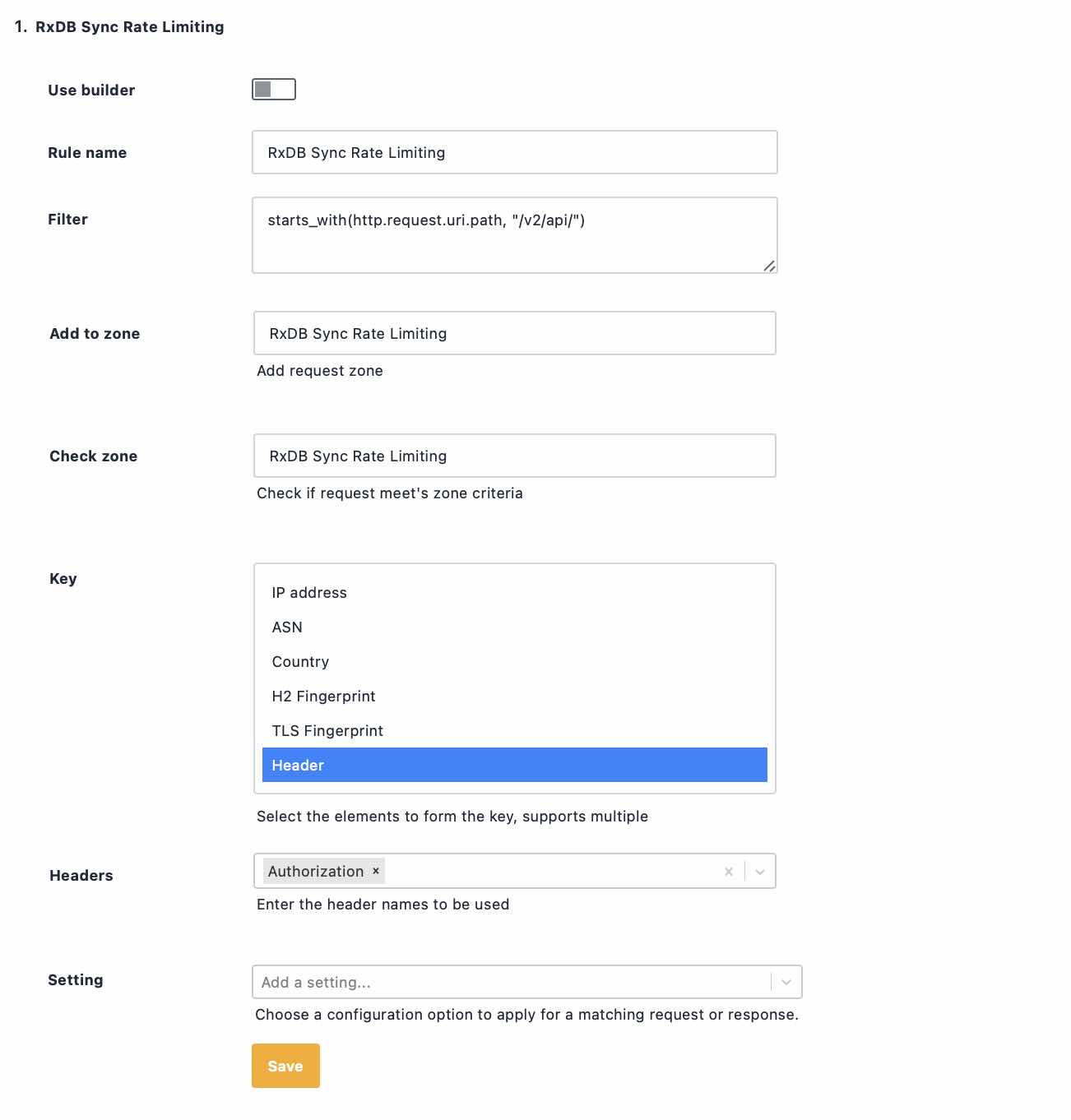
Advanced rate limiting is useful here because the counter does not have to be the source IP. For API traffic, a policy may key on an Authorization header, token, fingerprint, route, cookie, response code, or a combination of fields. For account flows, response-aware limits can count failed logins or suspicious reset attempts, then apply a stricter rule on the next request.
This matters for distributed abuse. If attackers rotate through residential proxies, a simple IP counter sees fragments. A route-aware, signal-aware policy can still recognise the behaviour that matters.
4. Preserve Evidence While the Control Runs
A security decision that cannot be explained will be difficult to tune and harder to defend internally. Teams need to know why a request was allowed, challenged, throttled, or blocked.
The evidence should keep the request, route, signal, policy, action, and outcome together. That includes useful fields such as the matched route, rate-limit zone, proxy or IP classification, fingerprint, response code, decision reason, and timestamp.
Log forwarding is part of the operating model, not an afterthought. If the evidence only exists in a dashboard screenshot or a short-lived edge event, support, fraud, platform, and security teams will end up reconstructing incidents by hand. Forwarded logs should carry enough context into the SIEM, object store, or observability pipeline for investigation and tuning.
This also protects the rollout. When a control is in monitor mode, evidence shows who would have been affected. When it is enforced, evidence shows who was affected and why.
5. Tune From Monitor to Enforce
The safest way to deploy account and API controls is usually staged:
- Monitor the route and collect baseline evidence.
- Add low-friction actions, such as logging or soft thresholds.
- Review false positives, support impact, and route ownership.
- Enforce on the clearest abuse patterns.
- Expand enforcement only where evidence supports it.
- Keep rollback and emergency tightening paths documented.
This avoids two common failures. The first is leaving controls in monitor mode forever because nobody owns the decision to enforce. The second is enforcing too broadly and creating customer friction that causes the business to bypass the control.
A staged model gives security, platform, product, and support teams a shared language. The rule is not "on" or "off". It has a route, a risk case, an action, evidence, and a review cycle.
6. Fit the Model to the Edge You Already Run
Some teams want Peakhour as the active application edge. Others need to keep Cloudflare, Fastly, CloudFront, another CDN, or an existing hosting edge in place. That deployment choice should not change the operating principle.
The goal is still to classify request context before origin, apply the right action, and preserve evidence. Bring Your Own Edge matters because many organisations cannot redesign delivery just to improve account protection. They need a control path that fits the architecture they already operate.
The practical test is straightforward: can the team explain what happened to a sensitive account or API request without guessing?
If the answer is no, the next step is not another generic control. It is an operating model: map the route, classify the signals, choose the action, preserve the evidence, and tune the policy from observed behaviour.
That is how API and account protection becomes something the organisation can run, not just something it bought.